How to Get Rid of Ants in Florida Quickly & Effectively
 September 10, 2026
1 min read
September 10, 2026
1 min read
Defend Your Yard & Home Against These Pesky Invaders
What’s In This Article?
- Confirm it’s ants, not termites, and identify the species, as treatment strategy depends on what you’re dealing with and where it nests
- Sprays only kill visible workers while the colony (and queen) survives underneath, so lasting control requires slow-acting bait that gets carried back to the nest
- Cut off food, water, and pheromone trails first to make any bait you introduce far more effective
- Treat the yard because indoor treatment alone won’t work if the colony’s actual source is outside untouched
- Seal entry points after treatment to prevent new colonies from simply repeating the cycle
- Learn more about ant control in Florida
Getting ahead of an ant problem in Central Florida means treating the cause, not just the symptoms you can see. Below is the approach Dr. Jack’s lawn care and pest control team uses, broken into steps that build on each other.
Step 1: Figure Out What You’re Dealing With
Not all ants behave the same way, so “getting rid of ants” looks different depending on the species. Some are drawn to sugar, others to grease and protein. Some nest entirely outdoors and only wander in for food. Others set up permanent shop inside your walls or under your flooring.
Before anything else, make sure it’s actually an ant. Ants and termites get mixed up constantly, and the two require completely different treatments.
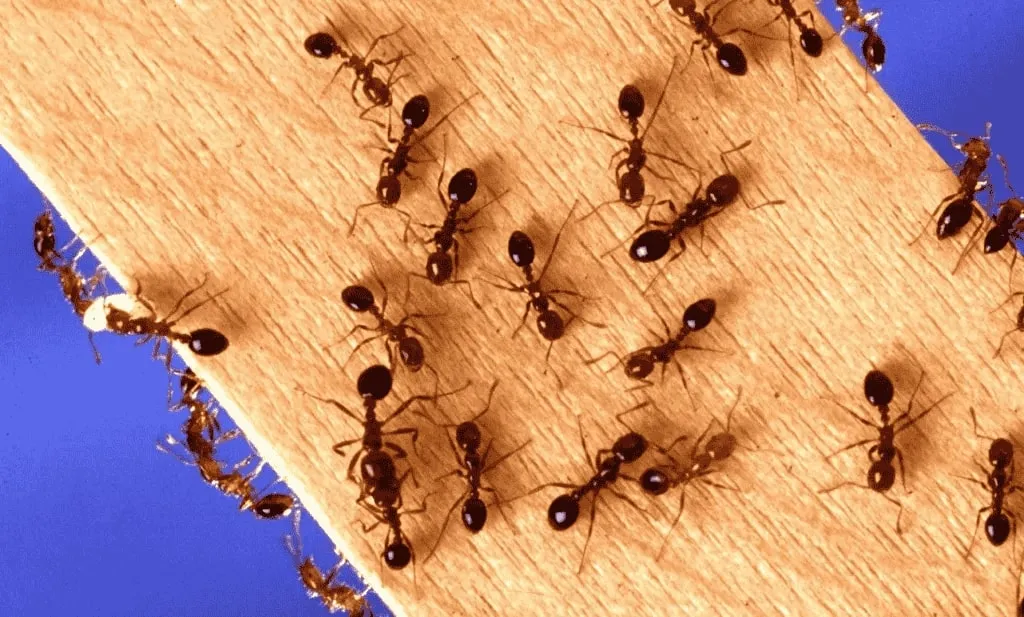
The easiest way to tell them apart is the body shape. There are lots of different kinds of ants, but they have a noticeably pinched waist between their thorax and abdomen, along with antennae that bend at an angle.
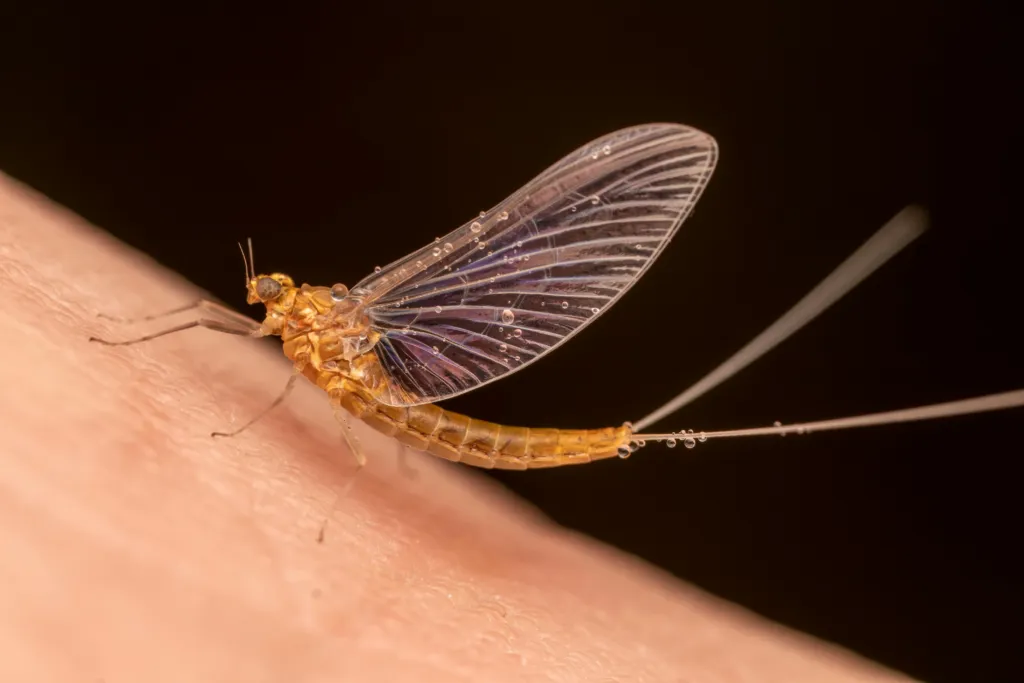
Termites’ bodies read as one smooth, tube-like segment, and their antennae run straight, almost like a tiny strand of beads.
Once you’ve confirmed it’s ants, a few clues can help narrow down the species: size, color, the path they travel, the smell when one is crushed, and where they seem to be coming from.
Signs worth taking seriously:
- Fine, sawdust-like debris (a sign of possible carpenter ant tunneling)
- Ants showing up in the same spot again and again, especially near food prep areas
- Trails running along baseboards, countertops, or walls
- Winged ants showing up indoors or swarming near the exterior
- Packaged food that’s been chewed into or contaminated
- Small mounds forming near the foundation or scattered through the yard
None of these are things to shrug off. Fire ants and carpenter ants in particular can turn into real problems fast, and any species left alone will simply keep growing its numbers.
Step 2: Understand Where They’re Coming From
Colonies aren’t small operations. They can range from a few hundred ants to several hundred thousand, depending on the species and how established the nest is. And they’re not picky about real estate.
Nests turn up underground, inside mulch beds, tucked beneath concrete slabs, behind wall panels, or inside decaying landscape timber. Anywhere that offers both shelter and a steady source of moisture.
Activity also shifts with the seasons. As temperatures warm up in spring, colonies come out of dormancy and foraging ramps up quickly.
By midsummer, populations are typically at their peak. Once fall arrives, ants start looking for warmth, which often means more of them showing up indoors. Sudden weather swings can speed all of this up too, pushing colonies to relocate or expand their search for resources.
Step 3: Cut Off What They’re After
Every ant in your kitchen is there for one of two things: food or water. And as they travel, they lay down an invisible pheromone trail so the rest of the colony can follow. Removing their reasons to be there in the first place disrupts that entire chain.
Start with food storage. Anything left in its original packaging is an easy target. Moving those items into sealed containers takes away the incentive almost entirely.
The same logic applies to crumbs and spills. Even a few minutes on the counter is enough time for ants to find them. Dishes sitting in the sink overnight and trash cans without tight-fitting lids send the same open invitation.
Moisture matters just as much as food, and it’s easy to overlook. A slow leak under a sink or around a toilet base can quietly sustain a colony’s water supply for weeks without anyone noticing. Check under sinks, around appliances like washers and dishwashers, and anywhere condensation tends to build up. Then fix what you find.
Step 4: Break the Trail They’re Following
Think of an ant trail as a communication line. As workers travel back and forth, they leave pheromone markers that guide the rest of the colony straight to the food source.
Wiping that trail out is simpler than it sounds. A diluted vinegar solution, warm soapy water, or even standard glass cleaner will strip the pheromones off most surfaces, leaving returning ants with no scent to follow.
This step alone won’t solve the underlying problem. As long as the colony and its food source both still exist, workers will re-lay a new trail before long. Think of trail disruption as prep work. It clears the slate so that when you introduce bait next, ants encounter it fresh, without an existing trail competing for their attention.
Step 5: Go After the Colony
Contact sprays feel productive. You see ants, you spray, they’re gone. However, sprays only reach the ants that happen to be out in the open at that moment.
The colony itself, tucked away and out of sight, is untouched. The queen keeps laying eggs, and replacement workers show up within days.
There’s also a downside most people don’t expect. Repellent sprays act like a warning sign to the colony that an area isn’t safe anymore. Some species respond by simply rerouting around the treated zone. Others, like pharaoh ants, respond by splitting off into new satellite colonies elsewhere in the home. In both cases, spraying can leave you with a wider problem than you started with.
This is where bait earns its reputation. Bait works with ant behavior instead of against it. Workers pick it up while foraging, carry it back to the nest, and share it throughout the colony through normal feeding behavior. That means the queen, larvae, and future reproductive ants all end up exposed, not just the ones you can see.
The slow-acting formula is intentional. It gives workers enough time to spread the bait through the colony before any alarm response sets in, which is exactly what makes it effective at the colony level rather than just the surface.
A few things to know about using bait correctly:
- A short-term uptick in ant activity around the bait is normal
- Leave bait in place and stocked for two to four weeks
- Place stations directly on the trail ants are already using, not nearby “just in case” spots
- Keep repellent sprays several feet away from any bait station
Step 6: Don’t Forget the Yard
Treating the inside of your home only solves half the equation. If the colony is actually living somewhere in your yard, ants will keep finding their way back in no matter how much you seal and bait indoors.
A few places worth checking outside:
- Around potted plants and anything sitting directly on soil
- Cracks and expansion joints in driveways, patios, and walkways
- Mulch and soil along the foundation, especially where it touches the siding directly
- Under flat stones, stepping pavers, or stacked landscape material
- Woodpiles and any decaying stumps nearby
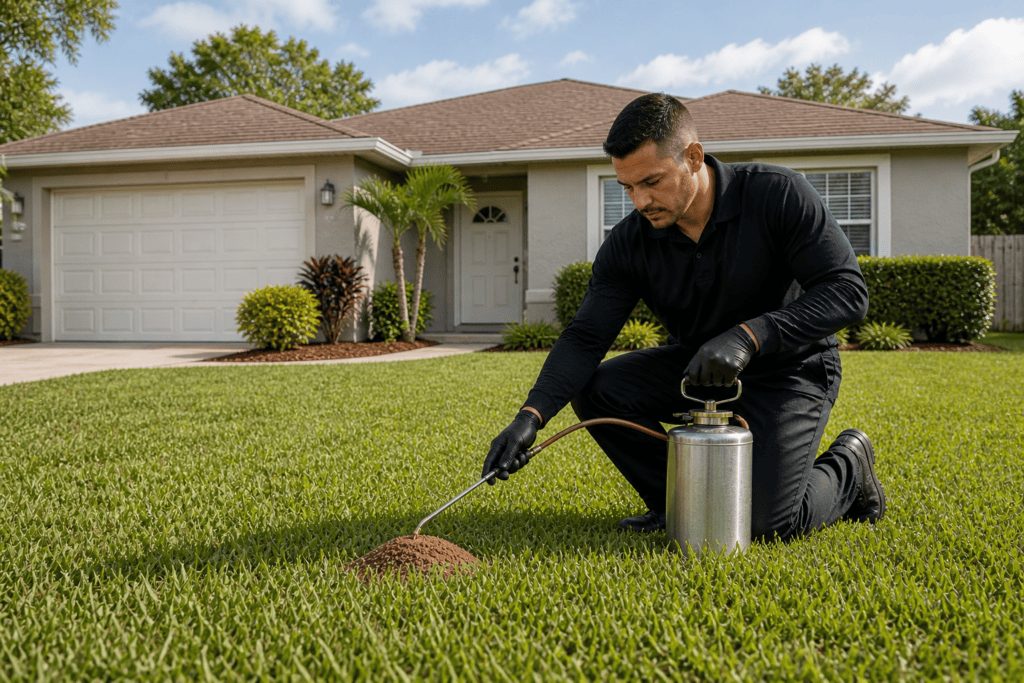
Follow an active trail away from the house instead of toward it. That reverse-tracing often leads straight to the nest entrance. From there, granular bait scattered along the trail and near the nest site tends to work well outdoors.
For broader perimeter treatment, non-repellent products are generally the better choice. They let ants walk through the treated zone without noticing anything’s wrong, so they carry the product back to the colony instead of just avoiding it. Repellent treatments, by contrast, just push the problem to a different part of the yard.
It’s also worth pulling mulch, soil, and thick vegetation back a few inches from the foundation wall. That small buffer removes shelter ants would otherwise use and makes it much easier to spot new activity early.
Step 7: Seal the Doors They’re Using
Treating an existing colony matters, but it won’t mean much if new ones can walk right back in through the same openings. Sealing entry points is what turns short-term relief into something that actually holds.
Trace active trails back to where they enter the structure. Common culprits include:
- Cracks in the foundation or gaps where siding transitions
- Vents, soffits, and openings around exhaust fans
- Worn seals around doors and windows
- Baseboards that have started pulling away from the wall or floor
- Openings where plumbing or utility lines pass through exterior walls
A short punch list for sealing up:
- Silicone caulk for most gaps
- Fresh weatherstripping wherever it’s cracked or compressed
- Patched or replaced window screens
- A careful check of nearby wood if carpenter ants are suspected
- Tree branches trimmed back from touching the roof or siding
- Firewood moved away from the foundation
- Mulch or soil cleared from direct contact with siding
What About Natural Ant Repellent Methods?
Borax bait is the one natural method with real colony-level potential. Mixed with a low concentration of sugar water (or peanut butter, for protein-seeking species), it functions a lot like commercial bait. For best results, remove any competing food sources nearby, and always keep the mixture well out of reach of kids and pets.
Food-grade diatomaceous earth works differently — it’s abrasive at a microscopic level, damaging an ant’s exoskeleton on contact and causing it to dehydrate. It’s a solid dry barrier near entry points, but it loses its effectiveness the moment it gets wet, so it shouldn’t be your only line of defense.
Vinegar, essential oils, and soap sprays are good for wiping out visible trails in the moment, but none of them do anything to the colony itself. Treat them as backup tools, not primary treatment.
Is It Possible to Get Rid of Ants for Good?
Not permanently. There will always be some pressure from neighboring yards and new colonies forming each season. What is achievable is consistent, manageable control that keeps your home ant-free year-round.
That usually comes down to a few habits: baiting preventively each spring before colonies hit full activity, keeping up with perimeter treatments through the warmer months, staying on top of sanitation and sealing, and acting quickly the moment you spot early signs of activity.
Still Seeing Ants? Here’s What Might Be Going Wrong
Ants are turning up in multiple rooms. This usually points to more than one entry point, a colony living inside a wall void, an unresolved moisture issue somewhere in the home, or outdoor vegetation providing a direct bridge into the house.
Bait is disappearing, but ants keep coming. There’s likely more than one colony, or an outdoor source that hasn’t been treated yet. Extend the bait window and take a closer look outside.
Ants are ignoring the bait entirely. Something nearby is more appealing to them. Clear out competing food sources, move the station directly onto the active trail, and double-check that the bait formula matches the species you’re dealing with.
Ants disappeared from one spot but showed up somewhere new. The colony likely scattered in response to a spray. Stop spraying near trails, wipe the area down to erase the old pheromone trail, and restart with bait plus outdoor treatment instead.
If you’ve worked through all of this and ants are still showing up, that’s a reasonable point to bring in a professional rather than keep troubleshooting solo — especially if you’re dealing with carpenter ants near structural wood, fire ants in a yard where kids or pets spend time, or an infestation that resets every year no matter what you try.
Common Ant Questions
Keeping Ants Out for Good
None of these steps are complicated on their own. The trick is doing them in order and not skipping ahead. Identify what you’re dealing with, remove what’s drawing them in, clear the trails, bait the colony (not just the ants on the surface), treat the yard, and seal the entry points they’ve been using.
Need help in your fight against ants and other lawn pests? Reach out to Dr. Jack’s today for professional care that works! We proudly offer lawn care and pest control services to the following areas in Central Florida: