
Discover the Species of Ants That Bug Homeowners in the Sunshine State
Article Brief:
- Why identifying your ant type before treating is extremely important + how to do it
- The ants most commonly found in Central Florida homes and yards, and what sets each one apart
- Why sprays often backfire, and which treatment approaches actually work
- How Florida’s unique climate impacts ant activity
- Get in touch with Dr. Jack’s for expert ant control and other pest control, lawn care, and shrub care services!
Figure Out What You’re Looking At
You don’t need to be an entomologist to narrow things down. A few minutes of observation goes a long way for ant control.
Start with location. Where are they foraging, and where does the trail seem to originate?
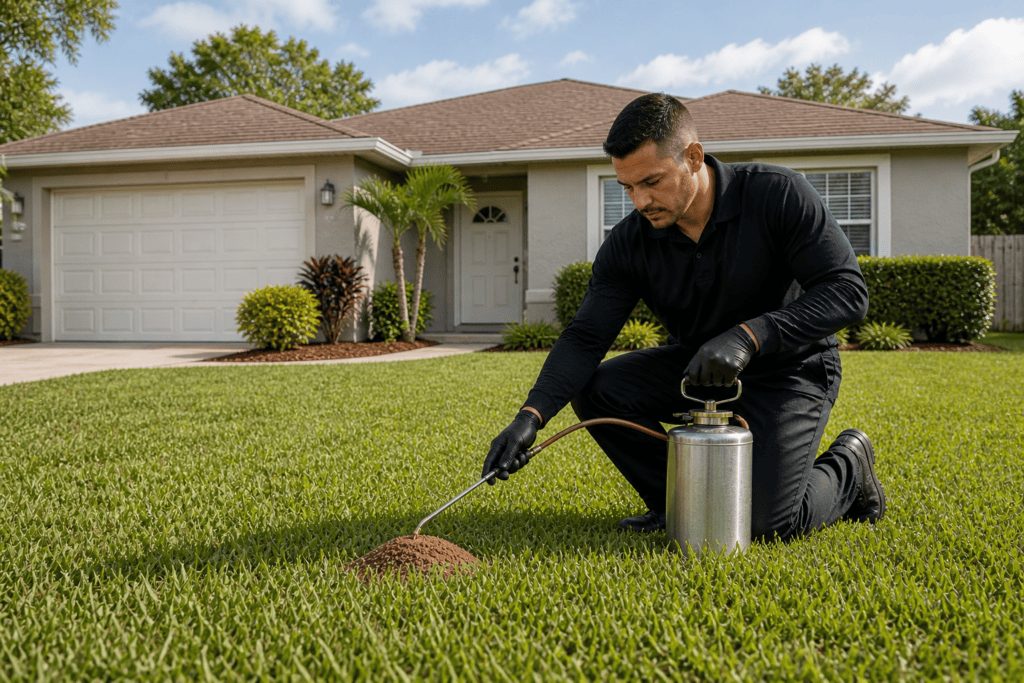
- A raised, dome-shaped mound in an open, sunny patch of lawn is usually fire ants.
- Sawdust-like material accumulating near a baseboard or window frame points toward carpenter ants.
- Mud channels running from soil to wood near a damp wall are typically moisture ants doing what moisture ants do.
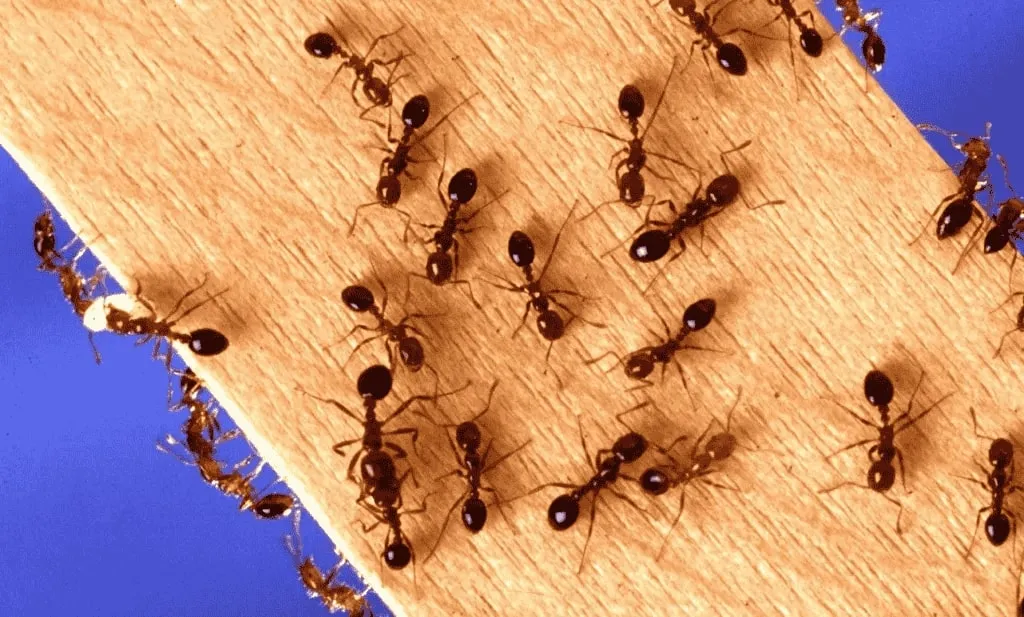
Look at size and color. Are they barely visible, or large enough to notice from across the room? Black, reddish-brown, pale yellow, or some mix of colors? Does the abdomen look elongated or almost heart-shaped?
Watch how they move. A single-file column suggests odorous house ants or Argentine ants. Ants moving in scattered, unpredictable directions with no apparent pattern could be crazy ants.
Use your nose. This one surprises people! Crushing a single ant and noting the smell is a reliable way to ID an ant.
- A rotten coconut odor points to odorous house ants or ghost ants.
- A sharp, chemical smell suggests something else entirely.
Put a few of these clues together and the list of likely suspects gets shorter. That’s when you can start thinking about treatment.
The Ants Most Likely to Show Up in Central Florida
Thousands of ant species exist across North America. A much smaller number show up in Florida homes and yards with any regularity. Here’s what you need to know about each one.
Pharaoh Ant
These are tiny (1.5 to 2 mm) and range in color from nearly translucent to pale yellow or light reddish-brown. They’re drawn to warm, humid environments and will nest inside walls, beneath flooring, and within virtually any protected void they can find.
Pharaoh ants are also documented carriers of dangerous pathogens, which puts them in a different risk category than most nuisance species. They’re also the species where conventional sprays cause the most direct harm to your treatment outcome.
When a pharaoh ant colony detects chemical disruption, it responds by splintering into multiple sub-colonies. One colony becomes several, and the problem gets bigger. Slow-acting bait, applied patiently and consistently, is the only method that produces reliable results with this species.
Twig Ant
Noticeably slender and elongated compared to most ants, often patterned in orange and black, with large eyes that give them an almost wasp-like look. They colonize hollow branches, dead twigs, and woody plant stems, and they’re common throughout Florida and across the Gulf South.
The main risk here is the sting. Twig ants are defensive when disturbed, and encounters happen most often during pruning, yardwork, or anything that puts your hands near shrubs and tree branches.
Ghost Ant
Ghost ants are small (about 1.5 mm) with a dark head and thorax that contrast sharply against pale, almost colorless legs and abdomen. Crush one and you’ll catch a faint coconut scent.
They’re primarily a warm-climate species and are especially widespread in Florida, drawn to sweet food sources and capable of slipping through tiny gaps.
Ghost ants maintain multiple queens across multiple dispersed nest sites, which means eliminating one location barely dents the population. Professional baiting programs produce far more consistent results than anything off the shelf.
Fire Ant
The mound is the giveaway. Fire ants build raised, dome-shaped structures, typically in open, sun-exposed areas of lawn.
What sets fire ants apart from a risk standpoint is that they sting rather than bite, injecting an alkaloid venom that produces an immediate burning sensation and raised pustules. For people with venom allergies, a disturbed mound is a genuine medical emergency. For everyone else, it’s still a situation worth avoiding.
When treating, spread granular bait across the surrounding area rather than applying product directly to the mound.
Citronella Ant (Yellow Ant)
Workers are 4 to 5 mm, yellow to amber in color, and unremarkable until the reproductive members of the colony take flight as winged, larger ants that are frequently mistaken for termites.
Citronella ants nest underground, particularly beneath concrete slabs, along building foundations, and in crawlspaces. The late-summer swarms can look alarming, but they pose no threat to wood, structures, or people. They’re short-lived and self-resolving.
Pavement Ant
Dark brown to nearly black, about 1/8 inch, found essentially everywhere in the country. Pavement ants excavate nests beneath stones, inside foundation cracks, and tight against the base of structures, pushing fine soil to the surface as they go.
Control here is more about environmental management than active treatment: address standing water near the foundation, seal exterior cracks, pull landscape plantings away from the building perimeter, and keep firewood stored away from the structure.
Thief Ant (Grease Ant)
Among the smallest household species at 1.5 to 2.2 mm, pale yellow to light brown, and named for a habit of setting up nests adjacent to other ant colonies and quietly raiding their food stores. They travel through wall voids and squeeze into tight crevices.
What distinguishes thief ants behaviorally is their preference for high-fat, high-protein foods over sweets. Standard sugar-based bait does very little against this species. Protein- or grease-based bait formulations are significantly more effective.
Acrobat Ant
Light to dark brownish-black, around 1/8 inch, with a heart-shaped abdomen that tilts upward when the ant feels threatened. That posture is where the name comes from.
Acrobat ants favor moist or water-damaged wood, often taking advantage of galleries already carved out by carpenter ants or following deteriorated insulation through a wall. An infestation almost always points back to a moisture problem somewhere. Fix the water source, and the ant problem tends to resolve itself.
Carpenter Ant
One of the largest species you’ll encounter indoors, with workers ranging from 1/4 to nearly 1 inch that are primarily black and mostly active after dark. Carpenter ants excavate wood, carving galleries through it to create nesting space. The sawdust-like frass they leave behind is typically the first sign homeowners notice.
Primary colonies usually live in a decaying stump or woodpile outside, with satellite colonies established inside the structure. Effective treatment requires locating and addressing the primary outdoor nest.
Army Ant
Roughly 1/4 inch, dark brown to black with a subtly orange-tinted abdomen and large mandibles built for subduing prey. What makes army ants genuinely unusual is that they form temporary living structures from their own bodies, with millions of individuals moving through an area before relocating. In the U.S., they’re largely confined to Florida, Texas, and the Gulf Coast.
They’re not structural pests, and they’re not interested in your kitchen. But a raiding column moving across a property is still worth addressing, especially if children or pets are in the yard.
Crazy Ant (Caribbean Crazy Ant)
About 1/8 inch, covered in reddish-brown hairs, and moving in the scattered, directionless pattern that gives them their common name. In Florida, crazy ants are active outdoors year-round and frequently push indoors after heavy rain or when outdoor temperatures shift.
Their multi-queen colony structure makes perimeter sprays almost useless as a standalone strategy. Effective management means sealing structural entry points, pulling vegetation back from the building exterior, and using bait that workers will carry back into the colony.
Little Black Ant
Very small (about 1/16 inch), uniformly black, with a clearly segmented two-node waist and no spines on the thorax. These nest primarily outdoors under rocks, in decaying wood, and beneath stacked materials, moving indoors to forage.
They’re more of a nuisance than a real threat. Caulking exterior entry points, storing firewood at least 20 feet from the structure, and keeping foundation plantings trimmed addresses most infestations without any product application at all.
Moisture Ant
Around 1/8 inch, yellowish to dark brown with a translucent abdomen. Moisture ants build distinctive mud channels connecting soil to wood, and they nest exclusively in wood that’s been compromised by water damage.
Their presence signals a water source that needs to be found and fixed. Treating the ants without addressing what’s attracting them in the first place is a short-term solution at best.
Odorous House Ant
Small (1/16 to 1/8 inch), brown to black, and one of the easier species to identify because crushed workers release a distinctly rotten coconut odor. They’re among the most widespread indoor ant species in the country, nesting inside wall voids, beneath sinks, and in damp soil adjacent to structures.
Spraying foraging workers doesn’t eliminate the colony. It just pushes it to relocate. Baiting along active foraging trails is what actually reaches the reproductive source of the problem.
Field Ant
Large workers ranging from 4 to 8 mm, red, black, or a combination of both, building flat, broad mounds up to several feet across in open, well-lit sections of lawn, meadow, and along fence lines.
Field ants bite and supplement the bite with a formic acid spray, which makes disturbing a mound genuinely unpleasant. Granular or liquid drench products designed for mound applications are the appropriate treatment.
Why Central Florida Has a Unique Ant Problem
Florida’s extended warm season changes typical ant management. Most species here remain active year-round to some degree, with activity peaking in spring and fall as colonies expand and ramp up foraging before and after the hottest summer months. That’s a considerably longer activity window than homeowners in cooler climates deal with.
Fall is when ants usually come indoors. As outdoor food sources thin out and temperatures moderate, foraging ranges expand. Colonies established near a structure’s heat can stay active through what passes for winter in Central Florida. If you’re seeing ants inside in October or November, that’s why.
Several species on this list (army ants, twig ants, Caribbean crazy ants) are either largely or entirely found in Florida, the Gulf Coast, and Texas. Their presence here is part of what makes ant management in this region more species-diverse and more complex.
How to Keep Ants From Coming Back
Yard and landscape management. Pull mulch back at least 12 inches from the foundation. Keep firewood stored well away from the structure, not against the wall or on the porch. Trim branches and shrubs that make direct contact with exterior surfaces.
Moisture control. Fix plumbing leaks. Keep gutters clear and make sure downspouts direct water well away from the foundation. Ants follow moisture. Cut off the source and you remove a major attractant.
Exclusion. Seal gaps around the foundation perimeter, door and window frames, and utility penetrations with a silicone-based caulk. Inspect weatherstripping and window screens for wear and replace them where needed.
Sanitation. Store food in sealed containers. Clean up spills and crumbs, including beneath and behind appliances where residue builds up quietly. Use lidded trash receptacles and empty them consistently.
These steps don’t guarantee a property will never see ants again, but they eliminate the conditions that make re-infestation almost automatic.
FAQs About Ants
-
What do winged ants mean?
These are called swarmers or alates, which are reproductive members of an established colony leaving to mate and start new colonies. Their appearance usually means there’s a mature colony somewhere nearby.
-
What ants smell like coconut when crushed?
Both odorous house ants and ghost ants produce that characteristic rotten coconut odor.
-
How do I find where ants are nesting?
Follow the foraging trail back toward its source.
-
Is bait actually better than spray?
For most indoor ant problems, yes. Spray kills the foraging workers you can see but leaves the colony intact. Bait gets carried back to the colony by those same workers, targeting the reproductive source of the infestation.
-
Which ants in Florida actually damage wood?
Carpenter ants and moisture ants are the two species most associated with wood damage in Florida homes.
Let’s Eradicate Those Different Types of Ants!
Want lasting results? Identify the right ant species, choose the right treatment for that species, and correct the underlying conditions that allowed the colony to establish. One of those steps without the others tends to be a temporary fix.
Need help in your fight against ants and other lawn pests? Reach out to Dr. Jack’s today for professional care that works! We proudly offer lawn care and pest control services to the following areas in Central Florida: